Who and what
The company, the documents, and the edges of this site
Three public documents sit behind everything written here. Each is real. None of them says what its name might lead you to assume, and this page shows all three so you can read them yourself.
The entity, as the documents describe it
- Legal nameNPX EXCHANGE LTD / NPX Exchange Ltd
- Address50 Fremont St, San Francisco, CA 94105
- EIN43-2165709
- MSB reg. no.31000342955903
- SEC CIK0002159385
- State of incorp.California
Read these as one sentence
A registered company with a tax number, a money-services registration and a securities notice on file. That is a description of administrative posture. It is not a statement about how customer assets are held, and it is not a safety rating.
Registration is not a license. A filing is not an approval.
The three documents
Shown in full, unedited. Under each one: what it proves, and what people commonly assume it proves but it does not.
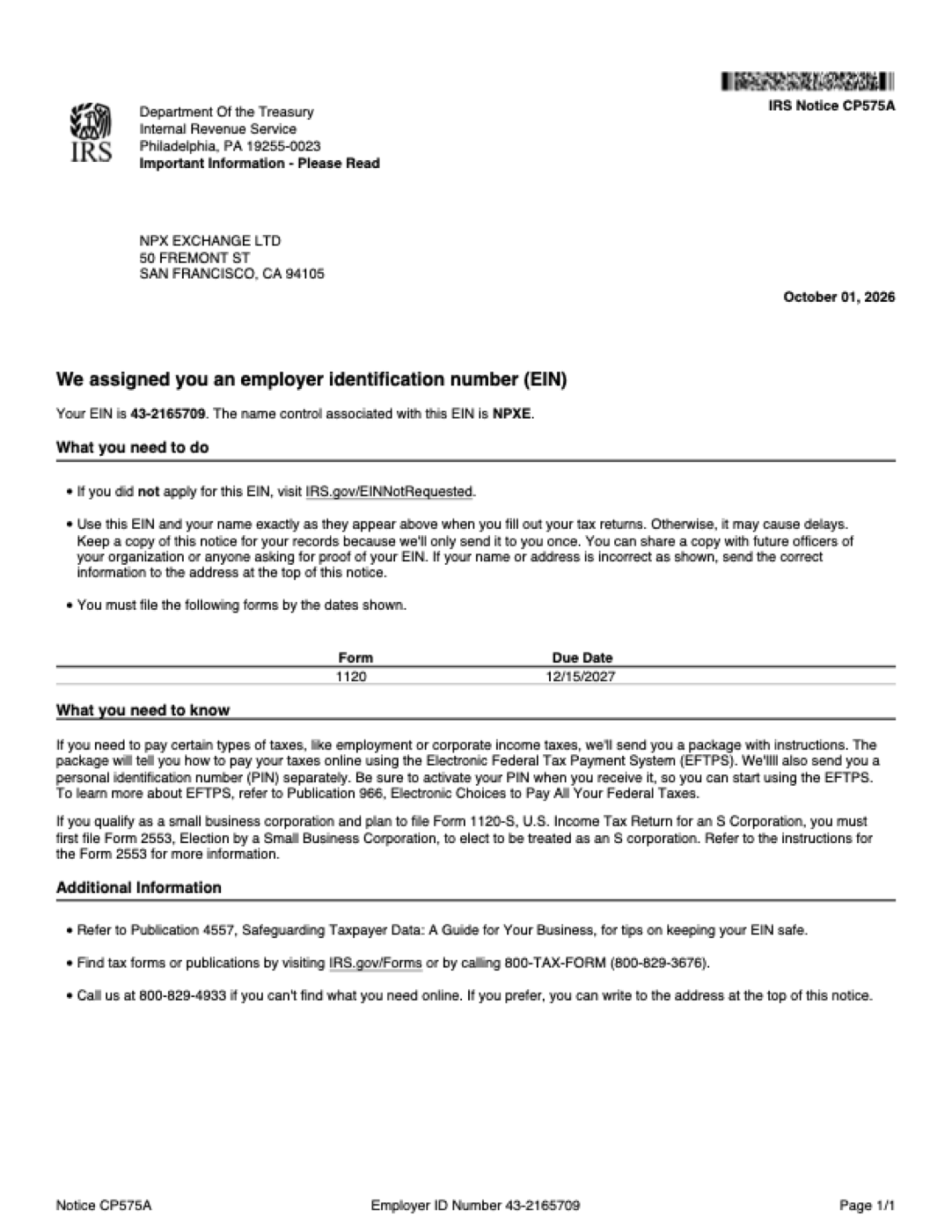
IRS Notice CP575A — the EIN
This is the letter the IRS sends when it assigns an employer identification number. It confirms the legal name, the address on file and the number itself: 43-2165709, with a name control of NPXE. It also notes that Form 1120 is due by 12/15/2027.
What it proves
That the IRS issued a federal tax identification number to this entity, under this name and address, on this date. That is the whole of it — an administrative record of a tax identity.
What it does not prove
That the company is licensed, regulated, supervised or approved to do anything. An EIN is not a permit, not a financial license and not a sign of financial health. It says nothing about how customer assets are held.
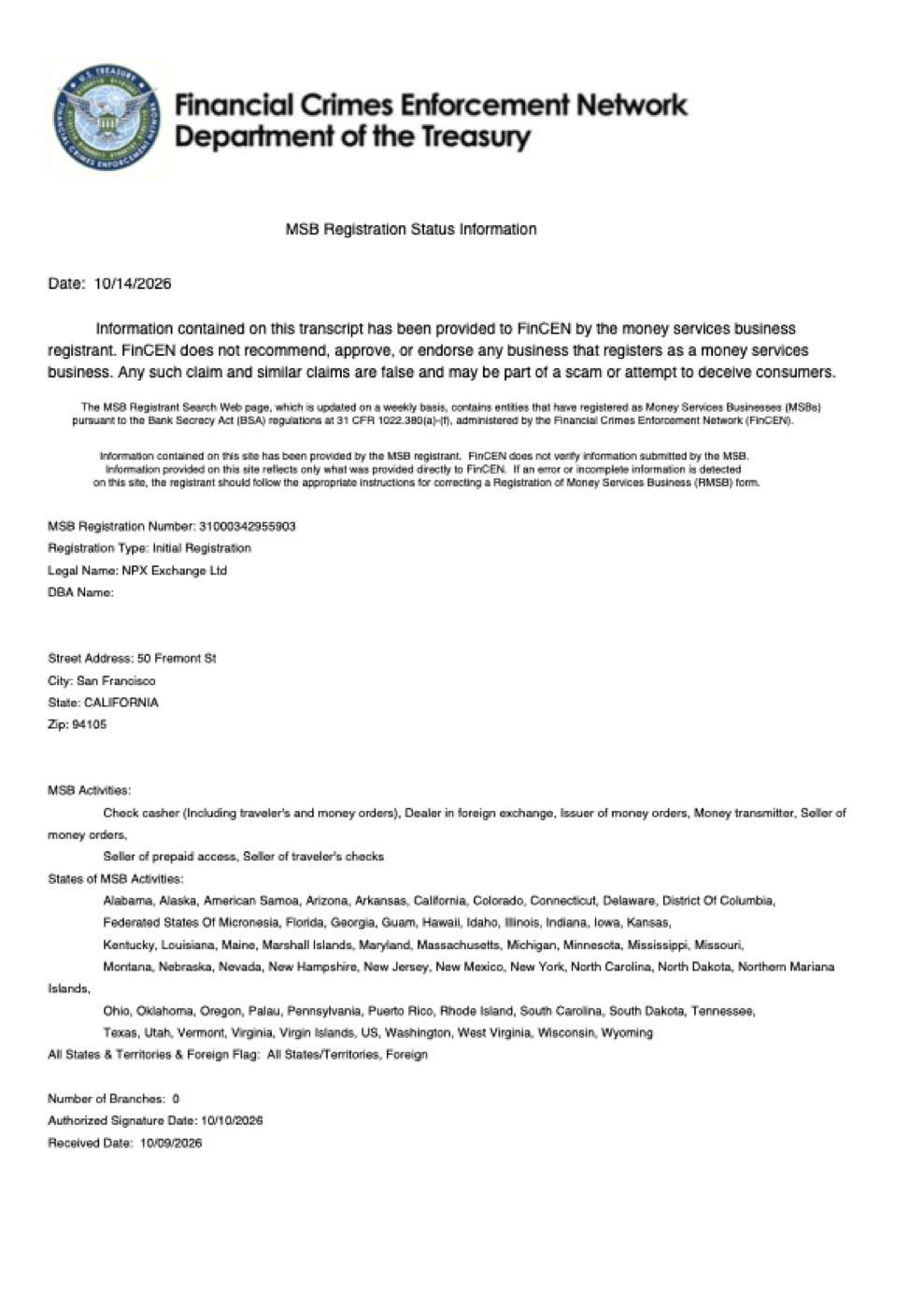
FinCEN MSB registration — not a license
A money services business that operates in the United States must register with FinCEN under the Bank Secrecy Act, at 31 CFR 1022.380. This extract shows the registration number, the type (initial registration), the legal name and address, the registered activities — money transmitter among them — and coverage across all US states and territories plus foreign. The number of branches is recorded as zero. The signature date is 10/10/2026 and the received date 10/09/2026.
What it proves
That NPX Exchange Ltd has registered with FinCEN as a money services business and reported money transmission among its activities. Registration is a filing obligation, and the record shows it was met.
What it does not prove
That FinCEN has approved, endorsed or examined anything. FinCEN says so itself. Registration is not a license, not a charter and not a guarantee that customer assets are safe.
“FinCEN does not recommend, approve, or endorse any business that registers as a money services business. Any such claim and similar claims are false and may be part of a scam or attempt to deceive consumers.”
— FinCEN, quoted from its own registration materials
Read that again if you have seen the registration described as an approval. The agency that issues it states that a claim of its endorsement is false. A company willing to show you this paragraph is telling you more than one that hides it.
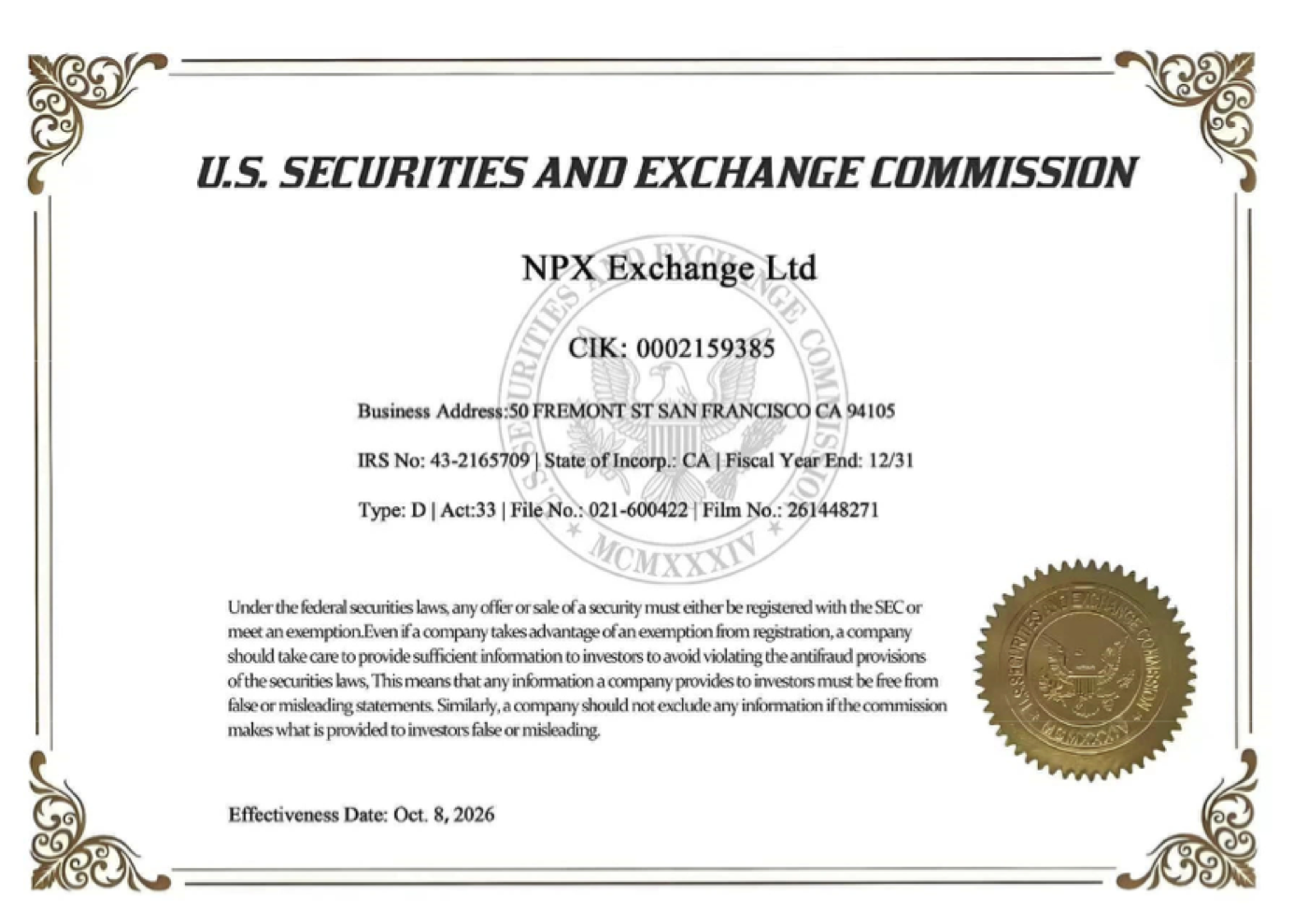
SEC Form D — a notice, not an approval
Form D is what a company files when it sells securities under an exemption from registration. The filing records the issuer, the CIK, the state of incorporation (California), the fiscal year end (12/31), the file number 021-600422 and an effectiveness date of October 8, 2026. It is a notice that an exempt offering is taking place.
What it proves
That a notice of an exempt offering was filed with the SEC and is on record. The company exists as an issuer, and the filing details match the other documents.
What it does not prove
That the SEC has cleared, reviewed or endorsed anything, or licensed the company. Form D is a notice filing, not a license of any kind, and it says nothing about client-asset custody.
Why this site keeps making the same point
Because the gap between what a document is called and what it does is where people get hurt. “EIN letter” sounds like permission. “MSB registration” sounds like a license. “Form D with the SEC” sounds like approval. None of the three is any of those things, and a site that lets you believe otherwise is not doing you a favor.
The three documents together establish a modest, verifiable set of facts: the entity exists, it has a federal tax number, it registered as a money services business, and it filed a notice of an exempt offering. Those are worth having. They are also entirely compatible with a company that holds customer assets badly — which is why the custody claim has to be assessed on its own terms, on the segregation page.
The scope of this site
This site is an explainer about client assets and withdrawal safety. It is written for someone who is about to make a first deposit and wants a plain account of what happens next. Its limits are deliberate and worth stating:
- It describes. Where a claim comes from the company, the text says so. Where a fact comes from a document, the document is shown.
- It has not audited NPX. Nothing here is the result of an inspection of accounts, systems, records or custody arrangements.
- It publishes no performance data. No user numbers, volumes, reserves, returns or insurance figures appear here, because none were provided and inventing them would be worse than leaving them out.
- It is not affiliated with any regulator. It is not FinCEN, not the IRS, not the SEC, and it does not speak for them.
- It is not advice. No part of it is investment, legal, tax or accounting advice, and nothing here is a solicitation to buy or sell anything.
Where to go next
If you want the documents read line by line, with the misreadings called out, the evidence archive is the place to start. If your question is about access control — who inside the company can move funds, and under what approval — security architecture covers it. If your question is about what happens during an incident or an outage, operational reliability is closer to the subject. And if you want the practical version of everything on this page, start with the withdrawal path.
One sentence worth keeping: a custodian should be judged by what it can show you, not by how confident its descriptions sound.
Important
This site presents corporate and operational information about NPX Exchange Ltd. Corporate registration, an EIN, an MSB registration and a Form D filing are not financial licenses, regulatory approvals or endorsements, and none of them guarantees the safety of customer assets. Digital assets are volatile and involve risk, including possible loss of principal. Nothing here is investment advice or a solicitation.